Showing posts with label bargains. Show all posts

Thursday, August 27, 2009

Sing me back home

I have not forgotten about this blog, I assure you, or about my New Year's-ish resolution to post something on some blog of mine somewhere every single day. Got a bit distracted from that mission, though, several months ago when my father died, a simple fact of life that has haunted my summer. In fact, I just got back from a return trip to my hometown to clear out his house--which, in the process, meant clearing out the last traces of myself from it, too. And that meant one final glimpse at the slowly decaying 8 track tapes that accompanied me (and the rest of the St. Louis High debate team) on many a car trip in the mid70s:


The last Ehmke family Oldsmobile with an 8-track deck died a decade and a half ago, but I can still tell you the contents of each and every one of these: America's Holiday album, Volume TWO of Gordon Lightfoot's pre-"Sundown" hits, Volume TWO of Walter/Wendy Carlos's pioneering Switched-On Bach, Don McLean's version of the obligatory contract-fulfilling covers album, the soundtrack album to the Robert Redford/Mia Farrow Great Gatsby, and so on. (All of these except Holiday and the Oldsmobile demonstration tape were purchased from the dollar bin at my local Musicland, which explains the high percentage of sequels and releases by artists rising up from or heading back to obscurity.) I don't see the live Jonathan Richman album here, which is a pity, for it is the one of which I have the fondest memories, since there was a problem with it and it kept playing the same "program" over and over again, making his epic eight-minute "Ice Cream Man" even longer than he intended. This is what the 1970s sounded like to me before Joe Strummer changed the game. I regret none of it.


More musical memories to come, plus several months' worth of postponed observations. I'm just trying to get back in the blogging groove again with an easy one.

Tuesday, March 17, 2009

Oh, Dannnny Boyyyyyyyy ...

So there we are, the husband and I, enjoying a lovely walk alongside the mighty Niagara on a sunny St. Patrick's Day, preparing for our collective future as an elderly suburban couple, when suddenly both of us think the same thing:

Are those bagpipes I hear?

And sure enough:


Happy Paddy Day.

PS. In the spirit of the holiday, allow me to recommend this wonderful album:


The bad news is, it's been discontinued by its manufacturer. The good news is, you can pick up a copy via Amazon for as low as 80 cents and enjoy some lovely and rare covers of traditional Irish tunes by the likes of Elvis Costello, Van Morrison, Sinead O'Connor, and Vince Gill for under a buck. That beats a green beer any day in my book.

Wednesday, February 25, 2009

Phases and stages

Yes, yes, we all know Best Buy and its ilk are evil, but now that they have driven most of my favorite indie record stores out of business, sometimes I am driven to visit a big box. Well, actually, it was the SnapTell app on my iPhone that sent me to BB in search of a lower price on a Nara Leão album I found at Borders recently. (Fun fact: "Nara Leão" sounds to me like someone trying to say "Laura Nyro" and getting tongue tied.) BB allegedly had the album for two bucks cheaper, but after searching every conceivable bin in the (surprisingly tiny) music section of a specific store in the hinterlands of suburbia--World Music, Latin, Jazz, Female Vocalists, Bargains, even Pop/Rock--I found no Leão whatsoever.

What I did find instead was quite possibly the best deal I've ever stumbled upon in my many decades of bargain-hunting:


this five-CD box set of classic Steve Reich works on Nonesuch. When I saw the $14.99 price tag, I thought at first it might be a typo for $149.99, but then vaguely remembered reading about this rock-bottom-priced set when it first came out in conjunction with Reich's 70th birthday. (There is, in fact, a $100 Reich box, but even that one seems reasonably priced, given that it contains a whoppin' TEN discs.)

The scanner at the cash register wanted to charge me $35, but I pointed to the sticker and sure enough, $15 is what I paid. Or would have been, had I not had 7 bucks remaining on a BB gift card a niece gave me for Christmas two years ago--meaning I just paid 8 bucks and change for 5 albums' worth of minimalist masterworks, including the pioneering early spoken-word tape loop piece "Come Out," the lovely song cycle Tehillim, all of Drumming, and the one and only Music for 18 Musicians, which I will forever associate with the foyer of a New Wave dance club back in the early 80s. I already have a lot of this stuff on vinyl, and my Reich/Glass "phase" ended a couple of decades ago, but something like this is too good to pass up. And for the record, "Come Out" sounds just as mind-blowing today as it did when I first heard it (let alone what it must have sounded like in 1966, long before Bush of Ghosts or before the sampled and looped human voice became ubiquitous on hordes of electronica and hiphop releases).

Wednesday, April 02, 2008

Shuffle Off #2: Mellow out, dude

A few weeks ago I was feeling a wee bit stressed out for various reasons, and thought it might be nice to fill the car CD player with relaxing music. It was also kinda cold, as I recall, so I went for sounds from warm climes. Here's the rundown:

1. Various artists, Hawaiian Slack Key Guitar Masters: Instrumental Collection. Picked this up in a giveaway bin at a past job around the time it came out in 1995; I tend to pull it out every few years and give it a spin or two, think to myself how pleasant it is, then put it back. Certainly does the trick in terms of calming jangled nerves, although in larger doses it's a bit too slack for my taste, so I actually took this out of the rotation first. I attribute the slight Muzak-y tendency to the fact that the label, Dancing Cat, is a subsidiary of Windham Hill. The only names I recognize on the lineup are Keola Beamer and Sonny Chillingworth, although I admit that I know next to nothing about the genre.


2. Kaouding Cissoko, Kora Revolution. Another freebie, and another disc that I play once or twice every few years. (Confession time: what first caught my eye was the cover art, and, believe it or not, the typography. 'Cuz I'm weird like that.) Interestingly, I tend to think of this as an instrumental album, but it turns out there are vocals all over it (the lyrics of which are translated and contextualized in the detailed CD booklet). That's a testament to the power of the kora playing here, which is incredibly lovely even if I don't get the "revolution" part. Cissoko has appeared on albums by Baba Maal and Nusrat Fateh Ali Khan, and if you like those guys, odds are good you'll enjoy this.

3. Various artists, Putumayo presents Cape Verde. I'm going to assume that if you know any musician from this series of islands off the coast of Senegal, it's Cesaria Evora. (If you don't know her stuff, better get busy.) Evora has one track here, but there are eleven other performers as well, and just about all of them sound fine in my book. Putumayo compilations can be hit-or-miss, but this seems pretty solid, steering clear of the label's Easy Listening for Sipping Espresso and/or Shopping tendency.


4. João Gilberto, João voz e violão. A really strong (if too-brief) collection of songs, most of which Gilberto has recorded elsewhere. The twist here, which I'll attribute to producer/protege Caetano Veloso, is that the sound is totally stripped down--nothing but JG's super-quiet voice and unaugmented guitar. Of the three or four Gilberto albums I've heard, this is an excellent starting point. Unlike discs 1-3 above and #5 below, I play this one fairly often; in fact, it took up residency near the bedroom CD player for about two or three years as a quiet-time staple.


5. Caetano Veloso, Orfeu. Speaking of Caetano, here he is in soundtrack-composer mode, creating new music for a remake of Black Orpheus, alongside covers of songs from the original. Some of this is orchestral instrumentals, some features vocals, and the range of tempos and textures is all over the map. I wouldn't recommend this as an introduction to Veloso, but it has many interesting moments. (Bonus: handsome booklet, with lyrics in both Portuguese and English plus stills from the movie that make me want to see it someday soon.)

6. Voodoo Child/Moby, The End of Everything. Sure, people give Moby a hard time for his ambient/instrumental projects (hell, some people give him a hard time just for being Moby), but I happen to like this a great deal: it's fairly low-key, with some majestic moments now and then, the whole of it bearing real emotional weight. I had this on as background as a party once and at least two people bought copies the next day. My only beef: what's the point of having a pseudonym if you're going to announce who you are on the album cover? So much for the anonymity of electronic music. (This being a Moby album, there is one of his characteristic mini-essay rants in the booklet, though it's mighty short and can be summed up in its final line: "Animals are not ours to eat, wear, or experiment on.")

Thursday, October 11, 2007

The Rainbow Connection


Try to forget, whydoncha, that it has been a mere 10 months since my last post here. Believe it or not, I've been trying all spring and summer to find some appropriate occasion to relaunch this blog, reasoning that once I start this thing up again, it will be that much easier to return to it, and while there have been plenty of possibilities--concerts, album purchases, holidays, going-out-of-business sales, and so on--none of them have managed to stick. So I'm choosing The Day After the Release of the Latest Radiohead Album. Sure, a lesser blogger might adopt something as pedestrian as the actual release date, and plenty of 'em did, but you expect more from me by now, and I accept the challenge. Now that everyone else has moved on to something else, I am here to weigh in on this whole crazy phenomenon:

1. First and foremost, I really like the album, based on two and three-quarters listens. I like it a lot.
2. I would be excited about a new Radiohead album even if it were just coming out as a plain old CD in the plain old way. When Hail to the Thief came out, I was right there at my favorite store at midnight, a 45-year-old in a sea of 20somethings.
3. Even so, this whole pay-what-you-want approach is just pretty damn brilliant. I love the questions it raises about art and commerce, for starters. A performance group I am part of strives to provoke similar discussions when we charge "your hourly wage" for our shows--but then we are reaching about 30 people a night, not several million. This is one case where the bigger the canvas, the more interesting the artwork.
4. A friend of mine who is not a Radiohead fan but does know a thing or two about the music industry views the pay-what-you-want experiment as purely a marketing gimmick that has nothing to do with art. I beg to differ: it may well be a publicity stunt (and an effective one at that), but it also works as a conceptual art piece, and is wholly of a piece with the band's M.O., not only in terms of business (I am reminded of the time they toured with their own big-top tent as a portable venue rather than deal with traditional arenas), but also the thematic content of their music (lotsa lyrics about the fate of the individual in a soulless corporatized environment; recurring juxtaposition of samples and electronic beats/noises with Thom Yorke's achingly human voice).
5. Another friend and I found it amusing that neither of us knew the titles of any of the songs yet, so we had to say things like, "I like track 4 a lot" and "Yeah, tracks 1 and 2 are so bombastic that track 3 really comes as a change of pace."
6. Lots of folks who don't really follow music have been hearing about this album via tech podcasts, business publications, news stories, and the like. I've been wondering what the hell they're going to make of such weird noise when they seek it out.
7. To all those netnerds who downloaded the album for free, then bitched about the low bitrate: this is how you say thanks when somebody gives you a present?
8. Then there's the snarkier-than-thou attitude that sneers at the whole idea of everybody listening to the album and then posting "insta-reviews" to their blogs, but I kinda like that part. As a guy with zero interest in Harry Potter, I've been missing out on the chance to experience the same pop culture artifact at the exact same time as everybody else. (I've always been intrigued by stories about the day that Sgt. Pepper came out and was played on a whole bunch of radio stations around the world in its entirety.) And I'm digging the notion that everybody--professional critics, self-appointed critics, megafans, casual listeners--was on a level playing field on Day One.
9. Fun bonus feature: Check out this handy track-by-track collection of videos documenting concert performances of the new songs.
10. Did I mention I like the album a lot?

OK, now that I've broken my silence, I'll do my best to get back into the virtual swing of things. Plenty to say, in due time, about what I've been up to when I haven't been up to blogging here, what I'm listening to, and all that jazz. For now, digging that album.

Friday, June 16, 2006

She's my shoo-shoo

Strangely enough, it was this post at my new favorite Beach Boys news source that alerted me to this interview with Sérgio Dias of Os Mutantes on the website of Light in the Attic Records. (They've got the first 8 Mutantes albums at around $14 apiece! As well as a whole bunch o' Free Design CDs for $10 each!)

The bottom of the OM Q&A page lists several tropicalia-related links, which is how I discovered the many Mutantes videos (mostly TV appearances) available via YouTube right now. Here's the grooviest of the 4 I've watched so far:


Remember, there's plenty more where that came from.

And doesn't this upcoming documentary look like a must-see?

Monday, November 14, 2005

Ten Cents a Dance

One good thing--probably the only good thing--about the current phase of endless changes in playback technology is the fact that stuff in outmoded formats gets remaindered at rock-bottom prices. I made out like a bandit when record stores got rid of all their vinyl in the late eighties, and the buck cassette has been a mainstay in my car for years. So imagine my delight upon discovering a bin of ten cent--yes, ten cent--cassettes at my local Media Play this past weekend. There wasn't a whole lot to choose from: lots of cassingles (I just love that word), British rap of the 80s, generic punk, etc. But for two dimes I walked home with a couple of interesting wild cards.

One was Angelus, a 1994 album by Milton Nascimento.


I haven't really heard that much of Nascimento's music, but based on my limited exposure I tend to agree (as almost always) with Joe Sixpack's assessment of the guy in his Brazilian Music Guide, and his mini-review of this album is right on the mark: Plenty of Milton's trademark falsetto ululations, framed by predictably lite fusion-pop. Several big name guest stars, including jazzcats Herbie Hancock, Pat Metheny, Wayne Shorter (and others) as well as Peter Gabriel, James Taylor, etc. Some interesting arrangements, but nothing that he hadn't done before. Most pretty cheesy.

There's an offbeat cover of the Beatles' "Hello Goodbye," and the song that J.T. guests on ("Only a Dream in Rio") at least starts off pretty nicely. (I was heavily into Mr. Taylor in my youth, but lost interest around the time he and Carly Simon split up and I discovered punk rock.) Several of the songs on side one of the tape are pretty okay, and I'm sure I'll listen to them again, but the longer the album goes on, the more grating it becomes. Maybe it will grow on me. My friend Heather is a big Milton fan, along with much of the music world and the entire nation of Brazil, so I'm willing to keep an open mind, but so far I don't get it.

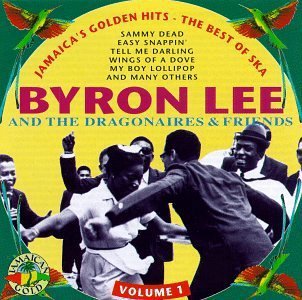
More appealing by far was/is Byron Lee and the Dragonaires & Friends, Vol. 1. (There seem to be three volumes in all.) This one's part of a series called "Jamaica's Golden Hits: The Best of Ska" on the Jamaican Gold label, focusing on the transition period between 50s R&B and early-60s ska.


I was pretty sure I recognized Lee's name from various compilations, and the cover art looked promising. Turns out, according to the All Music Guide entry on Lee, he was once the best-known Jamaican musician in the world, even making an appearance in the first James Bond movie, Dr. No. When the first-wave ska craze died down, he fell out of favor (and probably never had that much street cred to begin with) and spent the rest of his career doing covers of popular tunes of the day, from ska to rocksteady to soca.

The compilation I picked up is slightly weird, in that it's a mix of originals, covers, and selections where the original instrumental track has been paired with a new recording of a soundalike vocalist. This explains the opening selection, a cover of Millie Small's "My Boy Lollipop" in which Small has been replaced by what sounds like the Chipmunks. But the oddness is not too distracting; in fact, it's part of the charm. I love the lo-fi quality of the recordings, the energy level is great (and I say this as a man with little or no interest in the great Ska Revival Revival of the mid90s), and it's packed with catchy tunes. Can't wait to take a road trip with this on the car stereo. I was not familiar with the song "Oh Carolina," but fell in love with it immediately, thanks to the innovative use of an aerosol spray can as a percussion instrument (at least that's what I think is going on). There's also an instrumental version of "Ring of Fire" with a different name (actually, only the chorus was "Ring of Fire;" the verses might have been something entirely new). This was particularly intriguing since I first heard it on the way home from watching Walk the Line--a movie I intend to write about here, and soon. But I digress.

All in all, the best expenditure of twenty cents since ... well, I can't really think of anything else that cost that little in years. (A comic book circa 1967? A call from a pay phone in 1979?) Every time I buy a pre-recorded cassette, I figure it may be the last. If that turns out to be the case, I'll have gone out on one high note and one falsetto ululation. Not bad, not bad.

Thursday, November 03, 2005

I Found That Essence Rare

With all due respect to my indie-store-owning/label-running friends, I confess that I have been known to duck into chain stores from time to time. If I'm jonesing for a little record shoppin' and there's a Barnes & Noble or Media Play in the vicinity, you'll find me there. It's not pretty, but it's true. And, much as I hate to say it, the Brazilian bins at some of these joints are actually bigger and/or more interestingly stocked than the ones at the hipper/cooler shops in my neck of the woods.

So there I was, browsing my local Borders outlet, when I came across


this bargain-priced 3-disc Essential Guide to Brazil on the British budget label Union Square Music. Normally I'm wary of cheapie compilations like this, but the lineup of artists looked really promising--a mix of some I know and like (Getz, Veloso, Gil, Celso Fonseca, Zuco 103, Trio Mocotó), a couple I've been wanting to check out in more detail (Chico Buarque, Seu Jorge), and a bunch I've never heard of (Grupo Cabana, Zeca Pagodinho, Bob Azzam, and many more). There are several familiar songs, mostly by Jobim (the obligatory "Girl from Ipanema" is done by Paula Santoro), but plenty that I've never heard of. Of those, a super-catchy cover of "16 Tons" by Funk Como Le Gusta ("16 Toneladas") jumped out right away, along with a 50s-sounding novelty called "Crickets Sing for Ana Maria" by Marcos Valle, and Monica Vasconcelos' electronica-influenced take on "Bananeira" (Bebel Gilberto also does a version of this, and I'm pretty sure lots of other people do, too, since the melody is one I'm certain I heard long before I started listening to all this Brazilian stuff). Come to think of it, other than a pretty straightforward jazz piece ("Dado" by Bruno E) and some slightly muzak-y bits on Disc 1, there's not much on here that I don't like. For the price of a single CD, you get three albums that serve as a handy little guide to a lot of interesting artists worthy of further investigation.

I wouldn't really call this an "Essential Guide," mind you. I don't get the sense that there's a strong curatorial voice here. Each disc has a scholarly-looking theme--"Bossa Nova: The 60s Revolution," "Samba and the Samba Legacy," and "New Routes, Old Roots: Brazil 2K"--but these seem a little contrived, especially since the packaging is otherwise so astonishingly minimal. The image you see above appears on each of the slender cases, and there's nothing else to distinguish them--not even a disc number. Liner notes? Dream on.

Actually, notes for each song do exist online, at the label's website. They're short, but informative. Again, if you want to get your feet wet in the music of the region, this seems like a good, low-cost place to start. (FYI, at the same site you'll find a list of the other albums and sets on their roster, many of which also have online liner notes. I'm guessing the volumes devotes to Arabic and African music demonstrate the same strengths and weaknesses as the Brazilian one. Maybe the next time I find myself at Borders, I'll seek 'em out.)

Wednesday, October 19, 2005

Gonna Love You in My Chevy, Van

I thought sure I'd already obsessed somewhere around here about Van Morrison, but according to the "search this blog" feature in the toolbar above, I haven't. Sadly, time does not permit me to do so now, either, but suffice it to say I've been a fan since that night known so well to college kids the world round, when someone breaks out a bottle of wine and Moondance and you listen to that foghorn blow for the very first time and sail into the mystic.

That was my introduction, 25 years ago or so, to the romantic/poetic side of Van. But there are so very many more: the spiritual seeker, the blues revivalist, the Irish icon, the guy who gave the oldies stations of the world "Brown-Eyed Girl," and so on and so on. But my favorite Vancarnation (other than the maker of a string of breathlessly beautiful albums in the mid-to-late 70s) is The Eccentric Coot: the guy who's put out a number of 15-20-minute-long compositions built around endlessly repeated nonsense phrases and syllables, the one who gives really scary interviews, and, best of all, the man who recorded the legendary 1967 sessions which are now archived on WFMU's blog. They're all right there on the blog waiting for you to sample them: "Twist and Shake," "Shake and Roll," "Stomp and Scream" (and mucho additional variations); a similar batch titled "Blowin' Your Nose," "Nose in Your Blow," and the like; the only known blues lament to "Ringworm;" "You Say France and I Whistle" (that's pretty much the complete lyrics, as I recall); a bunch of possible "Madam George" precursors, including "Dum Dum George" (which might not be such a bad song to revive for the current presidential administration, come to think of it); and the self-reflexive "Freaky If You Got This Far," congratulating the listener for making it through all of the above. Best of all: "Big Fat Royalty Check," in which our hero is waiting for exactly that.

I think of this stuff (which I've got on a low-cost Charly boxed set called Payin' Dues) as a precursor to both Jonathan Richman and Public Image, Ltd., if you can imagine that unholy marriage. It's all just Van and an acoustic guitar, and it was never meant to be heard by the likes of you or I, and yet here it is. Freaky!

Wednesday, July 07, 2004

We're s-h-o-pp-i-ng... [SF report #2: consume-o-rama]

I can't imagine a visit to San Francisco without at least one trip to Amoeba Music or Rasputin Records. Don, whose shopping drug of choice is Home Depot rather than used and indie book and record stores, already knows what to expect on these adventures and patiently heads to the nearest coffeeshop after about 20 minutes in one of these joints. At that point, I'm just getting started. Two hours per store is cutting it short. And between the Berkeley and Haight locations of Amoeba—plus the Berkeley Rasputin and several Telegraph Ave. bookstores—we're talking major immersion, the kind you need strength training to endure.

Now, I'm not talking your average walk-in/walk-out shop here. According to a gushing 1998 profile in Rolling Stone, Amoeba stocks over 100,000 new and used CDs and LPs, which doesn't count other media—and in recent years they've added DVDs, just to push people like me over the edge. Factor in in-store concerts, live DJs, and rows and rows of cut-outs, and we're looking at major sensory overload.

Everyone I know who shops at either store employs a strategy similar to mine: pick a single category or genre or artist, pace yourself, and don't try to cover the entire store in one day. (It would be physically impossible, I think.) This time, no surprise, the target areas were the Brazilian and electronic sections, focusing almost exclusively on used stuff, with plenty of time in DVDland as well. Even so, I left each store feeling exhausted, depleted, and hungry for a walk outdoors. (Fortunately, between Golden Gate Park and the UC Berkeley campus, both locations offer ideal opportunities to recharge with sunshine and something resembling fresh air.)

About an hour and a half into my Haight Amoeba experience, I overheard a fellow shopper ask the employee in the World section (each section of the store has its own panel of experts) something about Brazilian music, so naturally I pricked up my ears and eavesdropped. Turns out that in addition to his record store job he "spins" (sorry, I've never been able to employ that term without the quotation marks) Latin sounds of various vintages, including samba, batucada, and "bossa beats," every Saturday at the Make-Out Room (3225 22nd St @ Mission) as DJ Vanka.

Listening in to their conversation didn't really lead me to any hot tips, so later I talked to him myself. Too fried to think of asking for useful buying suggestions, I mainly learned that he shared my mixed feelings about the father of samba soul, Tim Maia (i.e., a few nice tunes and a whole lot of appalling cheese, at least on the compilation I picked up used & cheap before the trip). From that somewhat limited vantage point, I asked for his opinions on three finds from the Used Brazilian section (yes, there really was such a thing, and it was larger than the new Brazilian holdings at most chain stores in Buffalo):

•Vinicius Cantuária, TUCUMÃ (Verve)--he knew the artist, but not that particular disc. [Now that I've heard it several times, I'd recommend it to anybody who wants a taste of recent singer/songwriters in the Veloso mold. The guest appearances by Laurie Anderson, Bill Frisell, Sean Lennon, and Arto Lindsay are an obvious bid to attract hipster Americanos, and the strategy works just fine as far as I'm concerned.]

•Rica Amabis, SAMBADELIC (YBrazil?)--he didn't know the album but recognized a few of the artists; it's unclear whether it's intended as a solo album or a compilation. [Turns out to be a pretty diverse collection of sampled beats, vintage samba soul, and found sounds with electronic dance music and a little hiphop; I really enjoy most of it.]

•BossaCucaNova, REVISITED CLASSICS (Six Degrees)--said he knew and didn't care for this one, which is basically the Slipcue take, too. "But," he added, "for five bucks, you can't go wrong." So I bought it anyway, and didn't go wrong at all. Normally I'm opposed to this sort of thing--take some old bossa nova tunes (or any raw material, for that matter) and spruce it up with some currently trendy electronic beats. (As Slipcue points out, it completely defeats the sublime subtlety of bossa to force a really obvious dance beat on top of it.) But I still enjoy it, partly because the source material is by some 50s vocalists (the Four-Freshmen-style Os Cariocas, for instance) I'd read about in Castro's book but never actually heard. At the end of the disc there are two tracks in their unembellished state so you can compare the originals to the remixes, and six minutes worth of "DJ beats" for your own sampling enjoyment. Plus, in the right mood, the dance mixes are perfectly enjoyable.

One final note from the trip: one of the few actual restaurants anywhere near our hotel happened to be Cafe do Brasil, which, thanks to its $7.95 lunch buffet, seemed a perfect place to sample the cuisine of the country whose culture I've been consuming so voraciously lately. (FYI, in searching for the restaurant's URL to post, I came across this somewhat skimpy list of Brazilian restaurants in SF, LA, Boston, NYC, and Miami, in case you're interested.)

Since we had no ground of comparison for the CDB, it's hard to say whether this was "good" Brazilian food or not, but frankly, neither of us was particularly impressed. (The coffee was excellent, but it's not a good sign when that's your favorite part of a meal.) Here's a thread from the Brazzil site on the search for Brazilian cuisine outside Brazil (and the political implications thereof) in which one writer describes CDB's food as "horrible." I wouldn't go that far by any means, but I also don't think I'd hurry back.

If nothing else, I learned one crucial culinary lesson: seeing a white-ish grain in a container the same size as that of the other entrees and sides, I took a decent sized helping, only to discover it had the texture and flavor of teeny tiny uncooked grits. My introduction to farofa, which (I learned from a restaurant review posted near the door on my way out) Brazilians evidently use as a garnish the way some people sprinke wheat germ on everything. Yum! Just the taste sensation I needed to fuel another long day in the CD bins...