Showing posts with label Gang of Four. Show all posts

Thursday, March 12, 2009

Sign o' the Times

Now, more than ever. Take it away, boys ...


Update, 3/17/09
The Gang's refrain "Comrades, let us seize the time" finds a 21st-century echo in the closing lines of this recent essay by Douglas Rushkoff about how the collapse of the stock market may not be such a bad thing, as found on Arthur's ever-provocative blog:

The current financial crisis is the best opportunity we have had in a very long time for a bloodless revolution against the faceless fascism under which we have been living, unaware, for much too long. Let us seize the day.

Saturday, January 06, 2007

Radio radio

I've been a huge fan of Pandora for close to two years now; actually my obession with it tends to wax and wane, but it's always there when I want it. If you've never checked it out yourself, give it a try--practically guaranteed to change your music-listening life--and if you're already hooked, you might want to investigate this list of 15 ways to get more out of Pandora. (Mac alert: many of these are PC-only, but the comments section of the post contains plenty of Mac-friendly variations.)

I found this item from LifeHacker, a long-established site I just recently discovered. I thik of it as a kind of "Hints from Heloise" for the tech generation. Today, for instance, there's a tip on wrapping headphones so they don't get tangled (although many commenters seem to prefer this method). Here's a quick link to LifeHacker's music-related tips.

Back to Pandora for a sec: as a soft-rock afficonado, one of my favorite stations out of 14 I've created is a salute to quiet pop mostly from the mid60s through the mid70s, but with a few more recent choices (since Pandora is built not around chronology or genre but the actual sound of a song). It's anchored to two bands: the Association and the Free Design. I call it ...

... Free Association.

While the Association and I go way back to my childhood (when my older sister somehow convinced me that "Windy" was about an owl), the Free Design (those current hipster darlings who emerged from Western New York in the late 60s) is much newer to me, and the station is a great way of working through their fairly large discography one song at a time.

In addition to the two namesake groups, this one plays songs by artists I already knew I liked (Badfinger, Wings, Andy Kim, Art Garfunkel and his sometime pal Paul, the Zombies, the Carpenters, Spanky & Our Gang, Todd Rundgren, Jim Croce, the Beach Boys, America, Steely Dan, and even the Velvet Undergound and Brian Eno) plus some I know but kinda cringe about (the New Christy Minstrels, Pure Prairie League, Showaddywaddy, the Anita Kerr Singers). But the real thrill is the growing list of acts I've never heard of till now. Some are solo performers old and new (Bob Dileo, Richard Swift, Pat Shannon, Sandy Salisbury, Jf Robitaille, Samantha Juste, Stan Rogers) and some are recent bands I've heard a teensy bit about (Ollabelle, Maritime). And then there's a steady stream of groups whose very names evoke a long-gone era I can't get enough of(Friends, Jon & Robin, Owl & the Pussycat, the Ivy League, Titus Groan, the Millenium, the Roosters, the Brokedown, Lady & Bird, Scene, Fancey, the Castaways, Gandalf). It's like a trip down somebody else's memory lane, and I dig it, man.

Saturday, October 15, 2005

Things I Found While Looking for Something Else, #2

So I'm online trying to find some important fact or other, and suddenly I decide to check out what's up with the CBC. (This can only mean there was something far more important on my to-do list, mind you.) I'd vaguely heard about a walkout a while back, but I'd sort of lost touch with the whole thing.

Turns out the official site is a bonanza of time-wasting diversions, starting with this not particularly revelatory "Protest Music Mixtape," which is really just a slide show with lengthy captions concerning the usual suspects.

I would not be wasting your time (only mine) with this information if that were the only thing I found. Nope, the real treasure trove came when I stumbled upon "the Alternative Canadian Walk of Fame" (or is it "the Canadian Alternative Walk of Fame"? the website lists both options--now, that's Canadian! And alternative, too...). The thirteen inductees include Tommy Chong, the Bob & Doug McKenzie movie, John "Plunderphonics" Oswald, and Chris Dedrick, founder of soft rock sensation The Free Design (originally from Western New York, by the bye, not our neighbor to the north, but so be it).

But two names on the list outshine all the others as far as I'm concerned. First and foremost is Mary Margaret O'Hara, whose lone full-length album, Miss America, is one of my all-time faves. I was lucky enough to see a concert of hers in NYC several years ago that was one of the most amazing things I've ever witnessed: an incredible balancing act between precision musicianship and a complete plunge off the deep end.

And speaking of the deep end, it is my great pleasure to introduce you to the second all-star on the Alternative Canadian/Canadian Alternative list: Nardwuar, the Human Serviette.


I first came across this singularly talented individual 6 or 7 years ago in the pages of Chart magazine, a Canadian (natch) music publication that I used to read as part of my record-label job. (I guess it wasn't technically part of my job to read the magazine, but I can assure you it helped me in ways I cannot begin to describe.) In every issue, Nardwuar would interview some unsuspecting musician or pop culture figure, asking a bizarre mix of incredibly stupid questions and incredibly well-informed ones. Sort of a precursor of Ali G, I guess (with a big touch of Tom Green, it occurs to me now that I've heard his voice)--only you frequently feared for the interviewer's safety. One month he's offering Henry Rollins a Powerbar at the end of a conversation, next month he's getting kicked out of a room by Courtney Love.

Now that I've found,or maybe re-found, his official website, containing not only written transcripts of the interviews but audio and sometimes video documentation of them, I may never be able to leave my computer again. There are years of these things to catch up on. Naturally I started with a 2005 interview with Dave Allen of Gang of Four, but the list of subjects/victims in the archives includes Geddy Lee, Gene Simmons, Gerald Ford (!), and Glenn Danzig--and that's only the letter "G." Enter this madness at your own risk. I cannot be responsible for the hours you are about to waste.

Oh, and that walkout?

Guess it's over now, but I completely forgot to look into it on the CBC site.

Thursday, August 25, 2005

The Way We Were

It's been a real trip down Punk Rock Memory Lane for me the last few days. I just watched We Jam Econo: The Story of the Minutemen, a 2005 documentary about my Second Favorite Band of All Time. At least that's what I used to call them, back in the early 80s, with tongue in cheek and hyperbole in full effect.

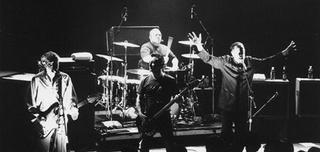
And a few days ago, this item I stumbled across at the info-packed music site Tiny Mix Tapes indirectly led me to a half-hour BBC radio documentary on my FAVORITE Band of All Time, Gang of Four. I'm still kicking myself for missing the Toronto stop on their current reunion tour last spring, and it doesn't look like there are any shows anywhere closer to me than Philadelphia in the fall. Perhaps I can ease the pain by listening to this US radio broadcast of a recent live show sooner or later.


(While I'm at it, here's...
the band's skimpy official UK site
a much more informative fan-run site,
Dave Allen's label/site/blog, and
Andy Gill's site, which includes info on his other production work, his studio, and other solo endeavors in addition to G4 content.)

I can't possibly overstate the importance of these two bands in my own life, particularly when I (like their members) was in my early twenties. They--along with the Clash (my Rolling Stones) and the Talking Heads (my Beatles)--showed me and like-minded folks my age around the country/world that radical art and radical music and radical politics could intersect and inform each other in all sorts of amazing ways. That you could combine danceable rhythms, complicated lyrics, and sheer noise to reach the body and the mind at the same time, albeit in different ways. That the most exciting music of the moment was not on commercial radio. That songs could be about something other than love, though they could also make room for the most romantic of notions.

I still remember standing in some indie record store on some road trip in December of 1985 learning that D. Boon had died the day before, and feeling heartbroken. That sadness came back as I watched the Minutemen movie (and damn if they didn't follow up the section on his death with an acoustic version of "History Lesson Part Two," the band's best and saddest song, just to rip me to pieces). The film isn't particularly impressive on a technical level (it combines long-lost, ultra lo-fi footage and new, student-level interview sequences shot on a shoestring budget), but I can't imagine any fan of the band minding very much. In fact, anything more high-quality would probably not feel true to the group's, and the era's, DIY spirit. I hope that younger people, and older folks who missed this music the first time around (like my partner, who was more of a Rush/Floyd/Sting fan than a punk rocker), can at least get the basic idea from the movie. (For their sake, it's kind of unfortunate that 95% of the music is live footage with crappy audio and intense performances that don't entirely translate on tape. It's definitely an exciting document of the times, but most of the band's recordings, while raw, were not nearly as crude sounding as the concert videos.)

I'm honestly not sure I'd still call the Minutemen my Second Favorite Band of All Time anymore. I really need to pull those old albums out again, but after hearing vast numbers of their songs for the first time in almost 20 years, I have a sneaking suspicion that they were the right music for a very particular moment in rock and in my own life, and that that moment is long gone. Which is fine; most of the band's songs, as various friends and colleagues note in the documentary, were designed to express a short, simple thought and then move aside for the next one, or ten, or twenty. They were like journal entries, or beat poetry, or improvised theater: here for one glorious instant, then gone.

As for the Gang, hey, I've got no problem permanently enshrining them at the top of my personal pantheon even today. It's sort of funny to see them become the influence du jour for a whole bunch of buzz bands (none of whom, I predict, will be so fondly remembered 20 years down their own road). They always did sound ahead of their time, and now that their time is here, I say, cash in, guys, you deserve it. Do the reunion tour, put out the remix album (even if it doesn't sound like a good idea to me), do whatever the hell you want. Let a hundred flowers bloom!

You may have noticed that this entry is probably the first time I've mentioned anything in this blog about punk (okay, postpunk), and one of the few in which I've said much about rock at all. And I gotta say, the older I've gotten, the less interested I've been in that whole world--not because I'm older, necessarily, but because I don't really think that that kind of music has evolved in very interesting ways in the last couple of decades. The Minutemen and Gang of Four (and, yes, some other bands of that era) blazed trails and suggested possibilities that most of their successors in rock haven't really picked up on yet (other than imitating their overall guitar sound and marketing it to a larger audience, which is not what I had in mind). I know that, at least for a few years in the late 90s, I heard some of that radical spark in electronic music, particularly in stuff by Autechre and Aphex Twin. But they're primarily instrumental, which means the political content is less overt. (By the way, there's an interesting moment in We Jam Econo where someone notes that the band's approach to music itself--scratchy, angular guitar, kept distinct from the bass--was a conscious political act.)

For large chunks of the movie, Mike Watt drives around his old stomping grounds in San Pedro, CA, pointing out the former sites of long-gone landmarks, retelling the band's story, and reflecting on its legacy. At one point he talks about how, in the 70s, musical options were far more limited than they are today: there were great big arena-rock bands, and tiny garage bands, and not much in between. Punk changed that, of course, and bands like the Minutemen pushed it even farther, suggesting connections between rock and a whole other universe of music: bebop, free jazz, c&w, reggae, psychedelia, you name it. That got me thinking about how punk became a jumping-off point for so many different things in the years that followed: one path led to 20 more years of generic hardcore, another path led to alt country, another to experimental/electronic stuff, and so on. I know for a fact that just about everything I've listened to obsessively since the days when punk really mattered to me--old-time country, 50s R&B, the Beach Boys, electronic(a), Brazilian stuff--is tied in one way or another to the noise I listened to when in various college dorm rooms and smoky clubs in 1979, even if the links aren't immediately apparent.

Punk gave American kids of the Ford/Carter era permission and encouragement to listen outside the box. Granted, for some of them, it quickly became a new, rigidly constructed box of its own. But for artists like the Minutemen--and those of us lucky enough to find out about them through the most haphazard of means--the world became a much bigger, more interesting place overnight.

Monday, June 21, 2004

"Disco e cultura"

From an All Music Guide essay on Brazilian music:

"The inscription 'Disco e cultura' (Records are culture) that appears on many Brazilian albums demonstrates an awareness on the part of Brazilians that their music is an authentic expression of who they are, that it is an uplifting, unifying force. It is at the same time a universal language understood everywhere, enriching all who listen."

Well, I'm never too sure about that "universal language" business (there are too many other factors that shape our taste and openness to individual works of art), but the rest of this strikes me as pretty interesting: the handy little motto, for starters, and the notion that record albums are as legitimate a contribution to culture as, say, books or movies. And there is something to be said for the way that a shared interest in a particular song or genre of music can bring people together.

That's what I like, and what I find frustrating, about Blogger's profile template: you're asked to name your favorite music (among other things), and then you can find out who else out there shares your taste in a given artist or song, which could certainly be a way to build community. But I find it really bothersome to have to isolate certain artists as "favorites." I like a lot of stuff from all over the map, and I don't really expect anybody else to enjoy both 70s-era Beach Boys and truly noisy Aphex Twin songs. And what qualifies as a favorite, anyway? I'm eager to hear from--and learn from--other folks who are fascinated by Brazilian sounds from the 40s through the current day, and that (incredibly broad range of) music is certainly a timely passion of mine, but over the course of my life people like Bob Dylan and Van Morrison (to say nothing of the Clash and Gang of 4) have played a much bigger role. Yet I'm not really that interested in tracking down more Clash fans; I don't think we have that much to say to each other beyond, "Yeah, that song is really good" or "Boy, it was sad when Joe Strummer died."

More to be said on all this when I'm not so sleepy.